Situation at a glance
- Industry: property technology, with a platform carrying operational and growth expectations.
- Platform decision: move toward EKS with private networking, access control, and observability designed together.
- Outcome framing: TCO and Well-Architected inputs support decisions, not public savings claims.
Context and legacy platform pressure
Core points
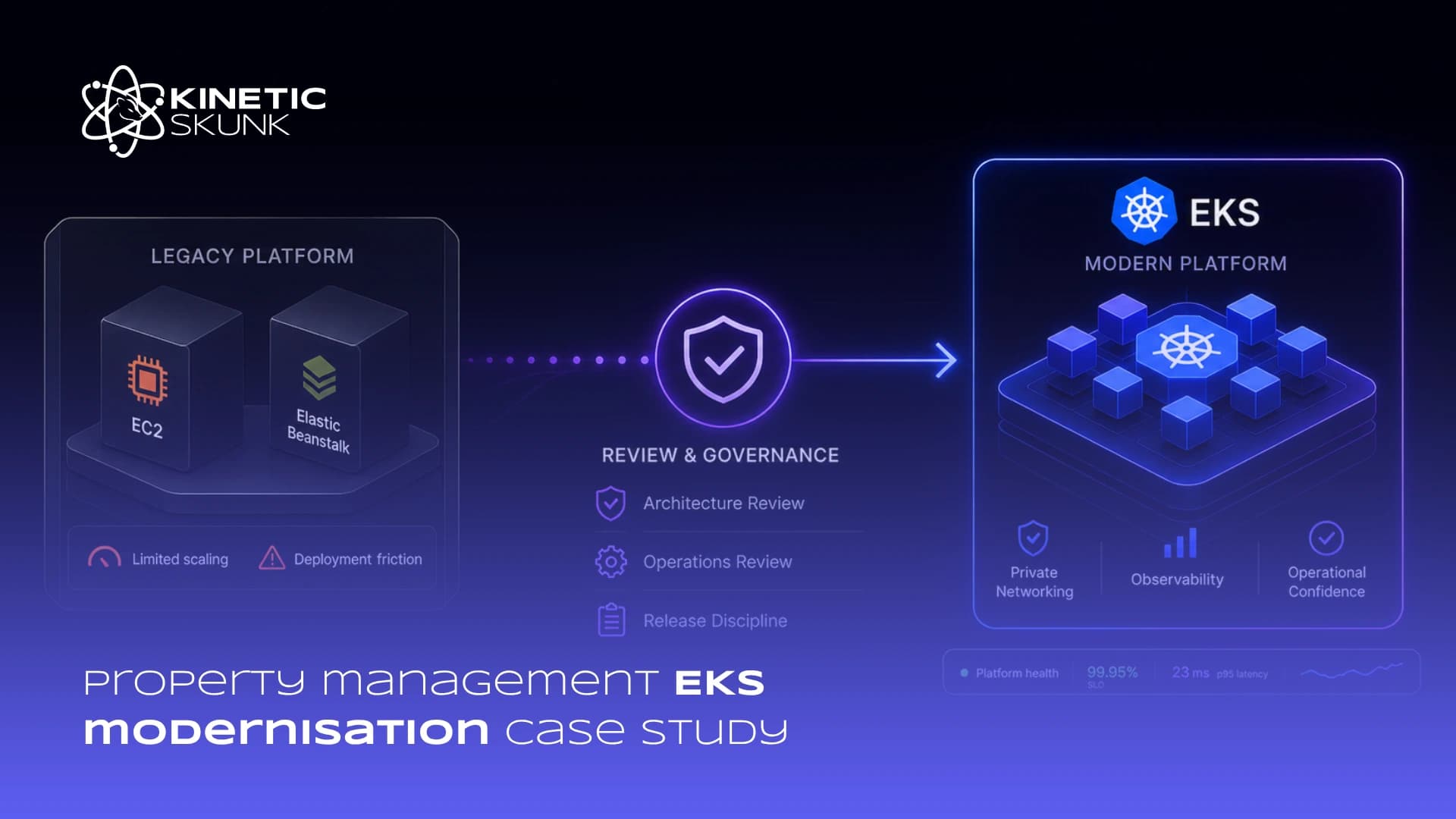
- A property management technology team needed to move beyond the limits of existing EC2 and Elastic Beanstalk patterns.
- The business needed a stronger cloud platform foundation that could support growth, reliability expectations, and clearer operational ownership.
- The modernisation needed practical evidence for cost, risk, and architecture decisions, not only a new runtime.
EKS architecture and service choices
Core points
- The platform direction moved toward Amazon EKS with multi-AZ managed node groups, private subnets, VPC controls, IAM, and network security controls.
- CloudWatch and CloudTrail supported monitoring, logging, and operating evidence.
- AWS Well-Architected Review and TCO analysis shaped the migration and modernisation approach without turning decision support into public savings claims.
Delivery milestones and operating controls
Core points
- Private networking, access control, monitoring, and logging were treated as core parts of the platform design.
- Architecture clarity improved because security, observability, and cost evidence were considered together.
- The work created a clearer foundation for leaders to decide what should move, what should change, and what needed more evidence.
Skunk tip
- Use the Well-Architected conversation to expose platform gaps before migration momentum hides them.
Measured outcomes and lessons
Core points
- The modernisation path improved architecture clarity, operational visibility, and the platform foundation for the property technology environment.
- Public outcomes remain qualitative unless specific approved evidence is supplied.
- The lesson is that Amazon EKS works best when paired with security, observability, review discipline, and leadership-level evidence.
Modernisation is not just a platform swap; it is a decision system for ownership, controls, and operating confidence.